How much does it cost to replace a concrete driveway with pavers, including tear-out?
Our paver driveways run $16 to $19 per sq ft installed, including excavation, compacted aggregate base, pavers, polymeric sand and cleanup. Tearing out the old concrete is priced separately as demolition, from $3 per sq ft, which includes load-out and dumpster haul-away. So plan on the paver price plus at least $3 per sq ft for tear-out.
Get my price →- $16–$19 per sq ft for a paver driveway installed
- From $3 per sq ft to demolish old concrete
- $12–$16 per sq ft for a new concrete driveway
- From $800 per load for extra debris hauling
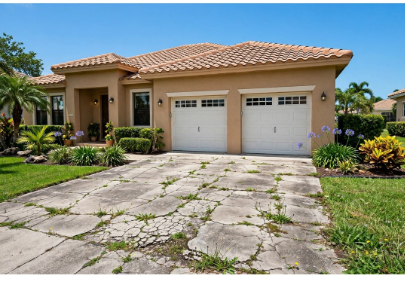 Before
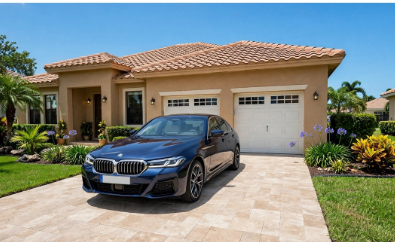 After
AfterThe Ultimate Paver Installation Guide: Why Substructure and Materials Matter
When planning a hardscape remodel, the visual appeal of the stones often takes center stage. However, the true success of your outdoor project rests entirely on meticulous engineering and proper site preparation. To ensure your investment stands the test of time, homeowners must look past the superficial surface aesthetics and focus deeply on structural integrity. Shoddy craftsmanship below ground will quickly ruin even the most expensive luxury stones above it.
How Do Substructure and Material Choices Impact the Longevity of Your Pavers?
The longevity of your pavers depends entirely on what lies beneath them. Poor drainage or an unstable base will cause shifting, cracking, and uneven surfaces over time. This makes excavation and sub-base compaction the most critical phases of construction. Standard driveways require a 4 to 6-inch compacted aggregate base to support heavy vehicular weight, while patios usually need 4 inches of stone base for pedestrian traffic. Skipping or rushing this essential step guarantees foundational failure when the underlying soil shifts, expands, or settles during seasonal weather changes.
Equally important is how the finished system handles water runoff. The surface must slope away from your home’s foundation—typically a 1-inch drop for every 4 to 8 feet—for proper drainage. Without this intentional pitch, pooling water will saturate the joints, erode the underlying base material, and eventually compromise your home's foundation or cause the pavers to sink.
Beyond what is hidden underground, the specific components used to lock the system into place dictate its lifespan. Remember that pavers come in various materials, thicknesses, and grading. You need to ensure the selected product matches the intended weight load of the space. Pedestrian walkways can handle thinner profiles, but driveways demand heavy-duty, vehicular-grade thick stones.
Once the correct pavers are laid over a solid base, they must be structurally locked from both the sides and the top to prevent shifting over time. Without solid edge restraints, such as concrete curbs or heavy-duty plastic edging, the perimeter pavers will drift outward under lateral pressure. Finally, always request polymeric sand for the interlocking joints. Unlike standard sand, it contains special chemical additives that activate with water to bind the pavers together. This prevents weed growth, deters burrowing insects, and washes away far less easily than standard joint sand, locking your hardscape into a unified, durable surface for decades to come.
Go to our website for an estimate and schedule to meet the team!
The founding partners have been in construction for over twenty years. Get your estimate now without the hassle for your next paver job!
How tear-out changes the price of a paver driveway
Swapping a concrete driveway for pavers is two jobs. First the old slab has to come out. Then the new paver driveway goes in.
We price these as separate lines. Breaking up and removing the old concrete falls under our demolition price, which is per square foot (see our price below). That covers protecting the work area, the demo itself, loading out and hauling away, and a broom-clean finish.
The new driveway is priced per square foot too (see our price below). That covers excavation, a compacted aggregate base, the pavers in your style and color, bedding and polymeric joint sand, installation and cleanup.
To get a rough total, measure your driveway's length and width and multiply them to get square feet. Run that number through both prices and add them together. Where your job lands in the paver range depends on things like the paver style, the shape of the driveway, how many cuts and curves it has, and how easy it is to get equipment to the site. If there is other junk or debris to clear before we start, a separate haul load may apply (see our price below).
Can pavers go right over my old concrete?
Sometimes it can be done, but it is often not the best choice. Here is why.
Pavers laid over a slab raise the driveway surface. That extra height can create a lip at the garage door, the sidewalk or the street. It can also change where rainwater flows. In Southwest Florida, water needs a clear path away from your home during summer storms.
The old slab also becomes the base. If it is cracked, sinking or heaved by tree roots, those problems can show up in the pavers above it. A paver driveway depends on what is under it. When the base is a compacted aggregate built for pavers, the surface can flex a little and drain through the joints the way it was designed to.
Our team will look at your slab before giving advice. If it is flat, solid and the height works, we will talk through your options. In most cases, though, we recommend removing the concrete and building a proper base. It costs more up front, but it avoids trip edges, drainage trouble and uneven pavers later.
Does a paver quote include removing the old concrete?
Not always. This is one of the most common surprises when homeowners compare quotes.
Many paver prices, including ours, include excavation and a compacted base. That means digging out soil and grass to the right depth. It does not always mean breaking up a 4-inch concrete slab and hauling the heavy pieces away. That is extra labor, equipment and dump weight.
When you compare quotes, ask each contractor these questions:
- Is removal of the existing concrete included, or priced separately?
- Who hauls the debris away, and is that in the price?
- Is the base material and compaction included?
- Is the edge restraint and joint sand included?
- Who pulls the permit, and is the permit fee included?
We list demolition and the paver driveway as separate line items so you can see exactly what you are paying for (see our price below). A low paver quote that leaves out tear-out or haul-away can end up costing more once those items are added back in.
Permits for replacing a driveway in Lee, Charlotte and Sarasota counties
Plan on a permit. Replacing a driveway usually needs one, even when you are only changing the material.
In unincorporated Lee County, the county's permit center lists a residential driveway permit, issued through Community Development. If you live inside a city, such as Cape Coral or Fort Myers, the city handles it instead. Cape Coral has its own permit for adding or replacing a residential driveway.
In Charlotte County, the county has a residential driveway permit. If the work is only in the public right-of-way, a right-of-way permit is used instead. Inside Punta Gorda city limits, check with the city.
In Sarasota County, any work in the public right-of-way needs approval. The apron where your driveway meets the street is often in the right-of-way, so this matters for most driveway jobs. Cities like Sarasota and Venice have their own permit offices.
Rules change, and they depend on your exact address. Our team checks which office covers your home and handles the permit as part of the job. If you are in an HOA, get their written approval for paver style and color before work starts.
Common questions
Can you put pavers over my old concrete driveway?
Our standard paver driveway price is based on excavation and a new compacted aggregate base, not laying pavers on top of a slab. Ask us during your estimate and we will look at your driveway and explain your options.
Does a paver quote include removing the old concrete?
No. Our paver price covers excavation, base, pavers, joint sand, installation and cleanup. Removing an existing concrete driveway is priced as demolition, from $3 per sq ft. The demolition price includes the load-out and dumpster haul-away. If you have other debris or junk to clear, that will be priced separately from $800 per load.
How much more is a paver driveway if I need the old one torn out?
Add demolition, which starts at $3 per sq ft, to the paver price of $16 to $19 per sq ft. Demolition includes protecting the work area, load-out, dumpster haul-away and a broom-clean finish.
Do I need a permit to replace my driveway?
It depends on where your home is. Your permit may come from a city or from the county, so check with the right building department before work starts.
Sources
- Install & Design price list · prices in this guide
- Charlotte County Community Development: Right-of-way Permit Requirements
- Charlotte County Engineering Design & Construction Standards
Checked October 2026.
Prices are planning estimates pending our team's review.